You’ve finished your book. Now how to describe it?

“It’s a book for kids–no, older than that–no, younger. Maybe.”

*throws hands in the air*

“It’s for everyone!”

(Reader, it’s not for everyone.)

You had a story to tell, and now you’ve told it. You just wanted to get it on paper/on your screen.

Because most people want to write a book.

And yet most people will never finish the first draft of their book.

Which already puts you ahead of the game, right?

Kidlit Reader Blueprint

But now, you have a finished draft. Maybe you’ve even revised it a time or two. And you’re ready to move forward with getting your book published.

There’s only one problem.

What type of kids’ book did you write?

A picture book, early reader, or chapter book? Or some sort of combination?

A chapter book or middle grade?

Or maybe middle grade or YA?

Why do I need to know my book’s category? Can’t I just call it a children’s book?

“Children’s book” means different things to different people. You have to be more specific. Why?

Because no matter how you plan to publish your book, you need to know who your book is written for.

Agents need to see that you understand the kidlit market and where your book fits in it.

And if you’re the publisher? You need to know which bookshelf to place your book on so that the right audience finds your book–and buys it.

Jennifer provides concise, insightful feedback tailored to publishing for children and young adults.

I had lost control of my story. It was too long for a picture book. Past critiques had been very general and lacking in suggestions on how to improve the story.

Jennifer helped me bring clarity to my story so I could cut down the word count and leave room for the illustrator..

I feel more confident sending it out to agents and look forward to getting my book published.

Introducing the Kidlit Reader Blueprint,
your customized guide so you can determine your book’s audience, confidently revise, and be ready to pitch your book.

In this comprehensive guide, you’ll receive

  • An analysis of where your book is right now
  • Pros and cons of choosing your book’s category and what that means for your audience
  • The information you need to know about the categories of kidlit and how publishers and retailers like Amazon categorize books for kids, tweens, and teens
  • Revision suggestions so your book will fit your chosen category
  • Context of the kidlit market so you can make smart decisions to market and sell your book
It was an amazing experience that helped me achieve the very thing I was looking for in an edit.

I had a great story but I wanted to elevate it and ensure I was delivering the words the right way. This story was inspired by true events, so I really wanted to make sure the manuscript delivered the right emotion. I didn’t want an editor that would strip the whole story of its true essence.

I was referred to Jennifer and trusted that she would be a good fit. I am so glad I did because it was such an amazing experience. It was so helpful to hear Jennifer walk me through her thoughts on different aspects of the edits she had made and why the changes might have been required. The edits really took my manuscript and helped me make sure my words were packed with the right emotions that I wanted for my book!

I have been so inspired knowing it is possible for my ideas to be transformed into an amazing story. I have now had people read the book and connect with the message, and I’m looking forward to writing more books!

Here's how it works:

Get Started

Click the green button to complete a short form. You’ll then receive a contract to sign and your invoice.

Let's Talk

Check your inbox for an email from me. This is where you’ll answer a few questions for me and upload your manuscript for review.

(Under 5,000 words? Send the whole thing. Longer? Send the first 5,000 words and a 1-page synopsis.)

Relax

Be on the lookout for your Kidlit Reader Blueprint in your inbox within two weeks. Read it, take it in, and then take a fresh look at your book.

As a new writer, I was looking for an editor that could assist with both development and traditional editing services. Jennifer provided both for me and did a fantastic job. She was great in giving suggestions but respecting the line between editor and writer. She provided a video clip of her edits so that I could completely understand the reasoning behind the notes that she was giving. I would recommend Jennifer as an editor.

You could ask beta readers how they would classify your book. But you might get a variety of answers (if they even respond to your emails).

Or you could go ahead and query, even though you’re uncertain. But with the time it takes to hear back from an agent, this could be wasting a lot of precious time.

Or you could self-publish and hope for the best. But if parents and teachers (not to mention, grandparents and librarians) can’t find your book, will kids ever get to read it?

The Kidlit Reader Blueprint is an investment that will pay dividends–not only for the book you’re currently writing, but for your future stories too.

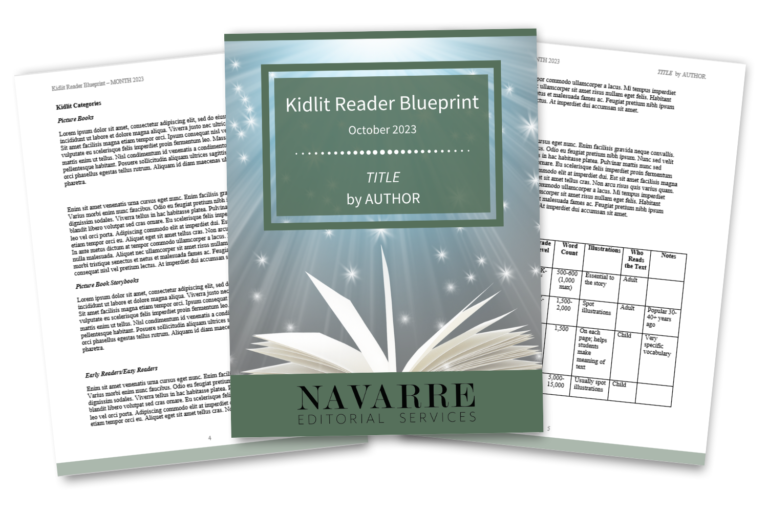
Blueprint mockup

Here’s what you’ll get in the Kidlit Reader Blueprint . . .

  • In-depth information about the categories of kidlit
  • An analysis of where your book is right now
  • Your book’s readability level, and why that’s important for kidlit
  • Pros and cons of categorizing your book one way or another
  • Illustrations: yes/no? And if yes, what kind?
  • Revision suggestions so your book will fit your chosen category

$300 USD

Jennifer improved our book series in a subtle yet profound way.

After writing our books, we were unsure if we needed an editor (WE DID). Would someone try and change too much of our story? Was it worth the investment?

Jennifer was extremely responsive, thorough, and knowledgeable. We felt supported before, during, and after the editing process, and we loved communicating with her through video; we felt like we were right in the room with her having a conversation.

During the edit, we learned more about rhyme and meter and how this would impact the flow of our books. We now feel so much more confident that our rhyme, meter, and sentence structure are cohesive throughout our series—and now that our Kickstarter campaign has been funded, we can’t wait to hold our printed books in our hands.

How to know if you’re a perfect match for the Kidlit Reader Blueprint:

  • You have a finished draft that you know is for kids or teens . . . but you’re not exactly sure who it’s really for.

  • You’ve asked around and gotten lots of feedback on who your story is for, but you’re ready for a professional opinion.

  • You’ve tried to find people to read your book, but finding beta readers is harder than it seems.

  • Your best friend/spouse/partner/neighbor/kid’s teacher read your book and said it’s great, but when you asked them to describe who it’s for, they said “Uh . . . kids?” with a sheepish grin.

  • You’ve done some research, and you can confidently say that your book . . . is a meld of two or three different categories right now. And while you know that’s not ideal, you don’t know how to tackle it on your own.

  • You’re ready to take the next step in your writing journey so you can someday publish your book–whether that’s through self-publishing or traditional publishing.

Are you ready to get started?